Validate Your Skills with NAHQ CPHQ Exam Dumps
Wiki Article
BTW, DOWNLOAD part of PassTestking CPHQ dumps from Cloud Storage: https://drive.google.com/open?id=1dVXfOqc-1ZZcjZxHT5GChLFBemCzdv8v
Hundreds of candidates want to get the Certified Professional in Healthcare Quality Examination (CPHQ) certification exam because it helps them in accelerating their NAHQ careers. Cracking the CPHQ exam of this credential is vital when it comes to the up gradation of their resume. The CPHQ Certification Exam helps students earn from online work and it also benefits them in order to get a job in any good tech company.
The benefits of becoming a CPHQ-certified professional are numerous. The credential is recognized by healthcare organizations worldwide as a mark of excellence in healthcare quality management. It can lead to increased career opportunities, higher salaries, and greater job security. CPHQ-certified professionals are also better equipped to deliver high-quality, patient-centered care and to drive improvements in healthcare outcomes.
Let New CPHQ Test Materials Help You Pass The Certified Professional in Healthcare Quality Examination
There are various individuals who have never shown up for the Certified Professional in Healthcare Quality Examination certification test as of now. They know close to nothing about the Certified Professional in Healthcare Quality Examination exam model and how to attempt the requests. NAHQ CPHQ Dumps give an unequivocal thought of the last preliminary of the year model and how a promising rookie ought to attempt the solicitation paper to score well.
NAHQ CPHQ Certification Exam is an essential credential for professionals who want to advance their careers in healthcare quality management. It provides a competitive edge in the job market and demonstrates an individual's commitment to providing high-quality patient care. Certified Professional in Healthcare Quality Examination certification is a testament to an individual's commitment to professional development and their ability to provide results-driven solutions to complex healthcare quality management challenges.
NAHQ Certified Professional in Healthcare Quality Examination Sample Questions (Q634-Q639):
NEW QUESTION # 634
A team has identified that labeled cutting boards are needed in a kitchen to decrease cross- contamination. After a new process has been implemented, it is discovered that the labeled cutting boards are not being used.
Which of the following is the next action the team should take?
- A. Initiate progressive discipline.
- B. Determine barriers to compliance.
- C. Increase monitoring.
- D. Conduct a root cause analysis.
Answer: B
Explanation:
When it is discovered that labeled cutting boards, which were introduced to decrease cross- contamination, are not being used, the next logical step is to determine barriers to compliance. This step is crucial for the following reasons:
Identifying the Root Cause: Before taking any corrective actions, it is important to understand why staff members are not using the labeled cutting boards. Barriers might include a lack of awareness, inadequate training, inconvenience, or resistance to change.
Addressing the Correct Issue: Without identifying the barriers, any action taken may not be effective. For instance, increasing monitoring or initiating discipline without understanding why the new process is not being followed could lead to frustration and further non-compliance.
Facilitating Improvement: Once the barriers are identified, targeted interventions can be developed. This might include additional training, revising the process for ease of use, or addressing any misconceptions about the importance of the change.
Ensuring Sustainability: By resolving the underlying issues that prevent compliance, the organization can ensure that the process improvement is sustained over time, leading to better outcomes.
Reference: (Based on Healthcare Quality NAHQ documents and resources) NAHQ CPHQ Study Guide, Section on Change Management and Compliance.
Quality Management in Health Care, Article on Identifying and Overcoming Barriers to Compliance.
NEW QUESTION # 635
A healthcare quality professional has been asked to assess a facility's patient safety culture. Which of the following should be surveyed?
- A. A random sample of leaders and staff
- B. A stratified sample of physicians and nurses
- C. All patients and their families
- D. All staff and physicians
Answer: D
Explanation:
Assessing a facility's patient safety culture involves evaluating the shared values, beliefs, and norms about patient safety within the organization. To gain a comprehensive understanding, it is essential to gather input from all individuals involved in patient care and organizational operations.
NEW QUESTION # 636
A Rapid Process Improvement Team began a new process on January 7 to reduce targeted events per bed day outcome. The team asked the quality analyst to help determine whether the new process was successful and should be continued. Based on the control chart the quality analyst produced, which of the following is the best conclusion?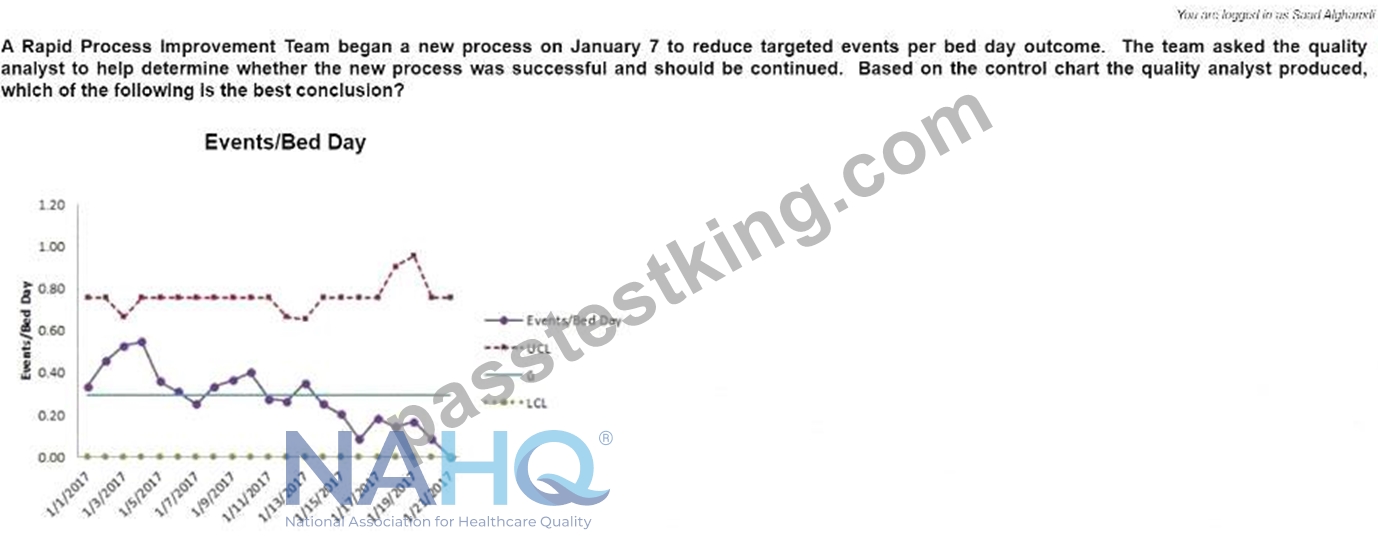
- A. There was a spike in the process, recommend discontinuing the process.
- B. There was an increasing shift in the process, recommend discontinuing the process.
- C. There was a decreasing shift in the process, recommend continuing the process.
- D. There was a decreasing trend in the process, recommend discontinuing the process.
Answer: C
Explanation:
* Reviewing the Control Chart DataThe control chart shows "Events/Bed Day" over time, with the Upper Control Limit (UCL), Lower Control Limit (LCL), and a center line (CL) marking the baseline average of the process before the intervention.
* Identifying the Impact of the New Process
* The intervention to reduce events per bed day was implemented on January 7.
* Following this date, there is a noticeable and consistent decrease in the number of events per bed day, with data points gradually moving downward.
* Eventually, the values settle well below the original center line, indicating a decreasing shift in the process.
* Differentiating Between Trends and Shifts
* A shift is characterized by a sustained change in process level, often due to a successful intervention, as seen here with lower event rates maintained over time.
* In this case, the shift is in a favorable direction, as the targeted events per bed day have reduced significantly and consistently.
* A trend would indicate a continuous movement in a direction, but this chart shows that after an initial decline, the process stabilizes at a lower rate.
* ConclusionSince the process has demonstrated a decreasing shift, indicating improvement and reduced events per bed day, the correct recommendation is to continue the process, as it appears successful in achieving the goal.
References:
* NAHQ "Statistical Process Control and Process Improvement Strategies"
* "Evaluating Shifts and Trends in Control Charts for Quality Improvement" (NAHQ, 2021)
NEW QUESTION # 637
An organization has compiled the scatter plots below: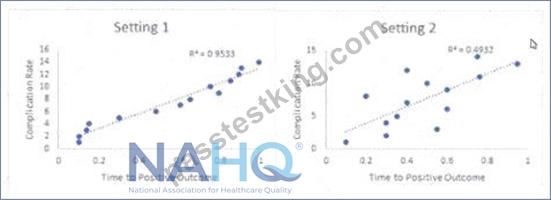
Based on these plots, which of the following conclusions can be made by the quality professional?
- A. Complication rates are causing longer time to positive outcome at settling 1.
- B. Setting 2 has a significant correlation between complication rate and time to positive outcome.
- C. Complication rates are not causing longer time to positive outcome at setting 2.
- D. Setting 1 has a strong positive correlation between complication rate and time to positive outcome.
Answer: D
Explanation:
* A scatter plot is a graphical tool that shows the relationship between two continuous variables by plotting data points at their corresponding values on the x-axis and y-axis1.
* To interpret a scatter plot, we need to look at the direction, strength, and shape of the relationship between the variables2.
* The direction of the relationship indicates whether the variables tend to increase or decrease together (positive correlation) or in opposite directions (negative correlation).
* The strength of the relationship indicates how closely the data points cluster around a line or curve that best fits the data. A common measure of the strength of the linear relationship is the correlation coefficient , which ranges from -1 to 1. The closer the absolute value of R is to 1, the stronger the linear relationship2.
* The shape of the relationship indicates whether the data points follow a straight line (linear relationship) or a curved pattern (nonlinear relationship).
* Based on these criteria, we can analyze the scatter plots for Setting 1 and Setting 2 as follows:
* Setting 1: The scatter plot shows a clear upward trend, indicating a positive correlation between complication rate and time to positive outcome. Thedata points are tightly clustered around a line, indicating a strong linear relationship. The R
What's more, part of that PassTestking CPHQ dumps now are free: https://drive.google.com/open?id=1dVXfOqc-1ZZcjZxHT5GChLFBemCzdv8v
Report this wiki page